
Be a Role Model (or an Influencer)!
Resuming my deep dive into Dr. Kim Nicholas’ five roles to take advantage of to help reduce environmental impacts, today’s topic is: being a role model. (See related posts from 5/3, 5/12, and 5/21.) This might be my favorite of the 5 roles Dr. Nicholas presents, because of its power and its universality. You may not realize it, but we are all role models, we are all influencers. (I know that “Influencer” has taken on a whole new meaning recently, but I’m here to reclaim the word for all of us.)
My Dad was a teacher, and one of his many quotable sayings about his profession was, “You’re always teaching something. What are you teaching when you’re not teaching?” The same can be said for our behaviors – you’re always influencing someone, so how are you influencing others when you don’t even realize it?
The personal experience that helped me understand this principle happened when I was in my late 20s and ran into one of my dearest childhood friends after losing touch for a few years. In the course of catching up, she told me about the years she had spent as a flight attendant after college and how much joy she got from traveling to places she had never expected to visit. Then she looked me in the eye and thanked me for making that possible. I had no idea what she was talking about. Then she said that through our friendship and my “tutoring” (I thought we were just doing homework together), she had gained confidence in herself that allowed her to pursue her dreams. I was shocked, thrilled for her, and deeply humbled. To think that loving a friend and connecting with her in such an ordinary way could change her life was flabbergasting. (And I can’t tell you how much it meant to me that she said it out loud.) At that point I truly understood that we are always influencing others, even when we don’t know it.

When I decided late in my career to accept an assignment working in sustainability, I knew it would change me, I just didn’t know how. Now I know. Once you understand what’s happening, you can never forget it, and you can rarely ignore it. You want everyone to understand what’s going on. But just dumping facts on people doesn’t change behavior. Behavior change is complicated, and it’s triggered and supported by multiple “levers,” including social influences. I’m sure you’ve heard and experienced that humans are social animals. As much as we in the US idealize independence, none of us is truly independent (and that’s a good thing!). From the time we are born until we die, we live in social groups that support us physically, emotionally, and spiritually. If you’ve ever paid attention to babies and toddlers, you know they learn (and survive) by watching and imitating others – parents, siblings, and caregivers. As they get older, kids continue to learn from these influencers but also start to imitate peers and others in the wider world, trying on new identities by imitating what they see. And this continues throughout our lives. We may get settled in a particular identity, but it still shifts over the years as we are influenced by friends, family, and the media.
Much of our behavior is based on conformance to social norms, that is, what is socially acceptable and/or expected. Our conformity may be due to simply noting what others are doing and deciding it’s a good idea, or by watching and listening to others and wanting to fit in, or by following the behaviors and beliefs of a group we identify with or belong to (e.g., political, religious, or peer groups).

Conforming to norms sometimes gets a bad rap, like when parents say, “What if all your friends jump off a bridge, are you going to jump, too?” But conforming to norms is essential to group cohesion and the success of a society. Norms provide predictability and consistency in relationships and group behaviors, smoothing the way for peaceful and productive interactions. But norms are not set in stone. If you’re at all aware of history, you know that what’s socially acceptable and expected changes, sometimes quickly. Just think of hairstyles (men’s or women’s) over the decades – what was cool and acceptable one year may have become totally cringe a few years later.
As Dr. Nicholas says, we can use role modeling to push society towards a better future. If you think recycling or solar panels or native plants or EVs will help get us there, go for it, and let your friends and neighbors know. It’s not a matter of cramming your beliefs down their throats or proselytizing, it’s just proudly doing your thing and quietly being a role model. Some good examples I’ve seen include:
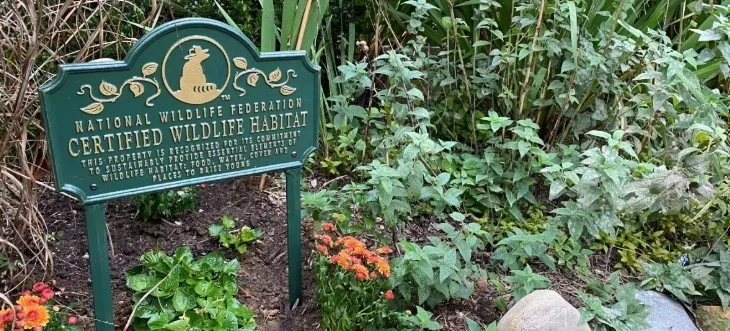
Creating a certified wildlife habitat in your yard, with a certification sign from the National Wildlife Federation,
Adding solar panels to your roof for all to see,
Getting a hybrid or electric vehicle when it’s time to replace your car and chatting with friends about it,
Posting photos of nature and life’s simple pleasures on social media instead of sharing images reflecting conspicuous consumption.
This is how norms shift – one person at a time. Be an influencer for a better future. That won’t change the world by itself, but it’s one of the easiest ways for everyone to make a difference. Like when I say, we’re all in this together, I’m hoping to influence you!