
Looking back to the 70s
A few weeks ago, I was “thrift store prospecting” and stumbled across this little gem: The Sun is Going Down for All of Us, compiled and edited by Jane Wilkie in 1971. After a quick glance through the book, including noting the price of $1.00 (slashed 2/3s from its original price of $3.00), I decided I needed to buy it.
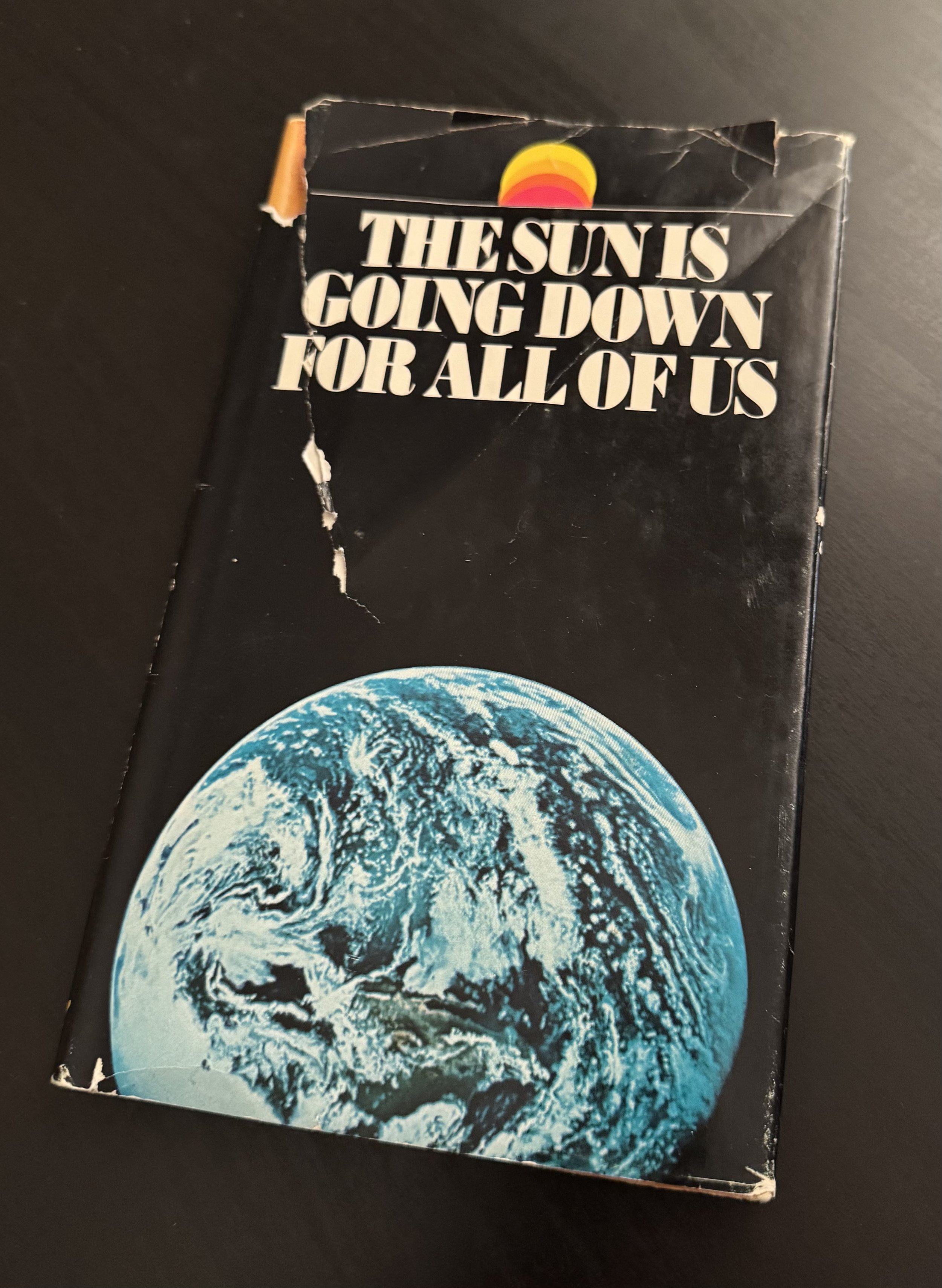
The Sun is Going Down for All of Us, Jane Wilkie
Seeing the subtitle of “Notes on the Murder of Mother Earth,” I was intrigued to be reminded of what people were thinking and writing about the environment 55 years ago. The book is a collection of statistics, quotes, and opinions, divided into sections like The Air, The Water, The Sea, Population, Food, Poisons, Sewage, etc. In my first read-through, I saw that some of the issues highlighted have gotten worse, some new issues have arisen, and we have made significant progress on some of them!
It made me think this would be a good place to start this blog series – highlighting the environmental problems that people have worked to solve since 1971 and reviewing where we stand today. First, let’s consider air pollution. Here are some quotes from the book:
Visible air pollution has been spotted over the North Pole.
Boston lives under an umbrella of dirt particles that is not dispersed by either rain or wind.
In the past ten years, the amount of junk in the air over the Hawaiian Islands has increased 35%.
While these statements don’t include documented statistics, information about air pollution in the 1970s is not hard to find. According to the Air Quality Life Index, the PM2.5 pollution (fine inhalable particulate matter) that Americans were exposed to in 2023, on average, was 64.9% less than in 1970. Just search “1970s smog” to see photos of how bad things were in major cities back then. But today, January 24, 2026, the air quality index in Boston is “Good”, with PM2.5 particulates at only 4 micrograms/m3.
So how did that happen? Did polluting manufacturers just decide to do the right thing? Did car makers spontaneously agree that it was time to build cleaner-burning, more efficient engines? Nope. The change happened because in 1970, 1977, and 1990 the US Government enacted amendments to earlier environmental legislation, creating the “Clean Air Act” as we now know it. And why did the Government pass that legislation? Because one junior senator provided leadership and then the people demanded it.
In 1970, Senator Gaylord Nelson (D) persuaded Congressman Pete McCloskey (R) to join him in promoting “teach-ins” on college campuses to spread the word about our deteriorating environment. A young activist named Denis Hayes organized teach-ins across the country and expanded the vision to include and inspire all Americans. This was the first Earth Day, which became the largest day of secular protest in history and inspired 20 million Americans (10% of the population at the time) to take to the streets to protest the ongoing devastation of the environment. These protests brought about the bipartisan support for environmental protection that led to the creation of the EPA and the modern Clean Air and Clean Water Acts. Meanwhile, the GDP continued to grow steadily after passage of these acts and cleaner air added 1.4 years to the life expectancy of the average American.
In the book, The Sun is Going Down for All of Us, there is one very interesting paragraph about global temperatures:
Due in great part to smog, the temperature of our planet has risen a half-degree in recent years. This doesn’t sound particularly sinister, but British scientists have affirmed that polar masses are already beginning to melt.
It appears that the author/editor of this book didn’t understand the science behind this temperature change or its implications, but at least the rising average temperature was mentioned. Today, we know from all reputable scientific sources that the global average temperature has risen approximately 1.4 ºC since 1860, coinciding with advancing industrialization. As far as the polar masses, according to NASA the ice sheets in Antarctica and Greenland, which store large amounts of fresh water on land, are steadily melting. Since 2002, the Antarctic ice mass has lost 135 billion metric tons per year, and the Greenland ice mass has lost 266 billion metric tons per year.
My takeaways:
We have a tremendous impact on the natural world
That impact can be devastating to humans as well as other animals and plants
We have the power to correct our mistakes, but it takes massive public action
Remember, we’re all in this together.
References: iqair.com, epa.gov, aqli.epic.uchicago.edu, nrdc.org, berkeleyearth.org, earthday.org, nasa.org