
Let’s Talk AI and Data Centers
As if life wasn’t complicated enough already, now we have AI and the resulting data centers to worry about. Coming from a background as a sustainability manager for a company building data centers, it’s not something I can forget or ignore. So, I want to cover the subject in a way that we can all wrap our heads around.
First, what is AI and why is everyone talking about it? AI, as you probably know, stands for Artificial Intelligence. But what does that mean? AI is a broad field of technological development that enables computers to simulate human learning, information processing, problem solving, and decision-making. Advanced models are now performing activities that also simulate human creativity and autonomy.
Some early forms of AI were computers that could play games like chess (and win) and language translation programs. The AI branch known as Machine Learning includes programs that use an algorithm (a set of rules and procedures) to analyze large data sets and make predictions, like the programs that customize your social media feeds. Machine Learning also extends to what’s called Deep Learning – the kind of complex computation used to analyze and learn from large amounts of complex, unstructured data, like the processing done by new cars to control your speed, keep you in your lane, brake for you, and notify you of speed limit changes.
But the AI that is all the buzz now is Generative AI. Generative AI is a Machine Learning model that is trained to actually create new information based on the data it was trained on. Generative AI has been used in its simplest form for decades, like text prediction that tries to generate the next word in the sentence you’re typing. But until a few years ago, Generative AI was working from small data sets, so its “thinking” was limited. Developers around the world understood that with more sophisticated programming architecture and larger data sets, AI could be trained to process information and generate data more and more like humans do, and the race was on. Now there are multiple large data set Generative AI programs available for everyday use. But since they’re in continuous development and are “learning” all the time, it’s unclear where they will lead.
The one thing we do know is that Pandora’s Box has been opened and Generative AI is here to stay. People in all fields have embraced it as a way to do their jobs better, solve seemingly intractable problems, and work more efficiently. It’s already being used to detect and treat life-threatening health problems, predict and mitigate climate change impacts, find and remove toxic lead pipes, and find unexploded landmines, for just a few examples.
But there are significant downsides. The first problem that springs to my mind is that the developers of Generative AI (like previous tech) lack adequate representation by womenand people of color. Before you roll your eyes too hard, remember that we each have a narrow range of experience and we “don’t know what we don’t know.” Just think of it as “potential bias from incomplete data.” Balanced representation by all groups will help prevent creation and exacerbation of social inequities.
As the child of educators, the next problem that concerns me is how dependence on technology reduces critical thinking skills. There are lots of scientific studies out there confirming this, if you like reading scientific papers. But if you want a nice summary (with lots of resource links) from an actual student who is a research intern at University of Michigan, check out Kate Hurley’s The Paradox of AI Assistance: Better Results, Worse Thinking, on Educause Review.
But the problem that falls into my realm is the impact of the explosion of Generative AI on the environment. Data centers have been around for quite a while, serving as storage and processing centers for all of our emails, chats, websites, Amazon orders, and everything else we do on the internet. But their recent expansion is directly related to Generative AI. Imagine all of the computer processing that needs to happen, first to create and train Generative AI systems (which will be ongoing), and then to use them for all the tasks people will want them to do. If you use ChatGPT, Copilot, Google Gemini, DeepSeek, Claude, or any other new AI tool, you’re adding to that load. Hence the proliferation of new data centers across the US.
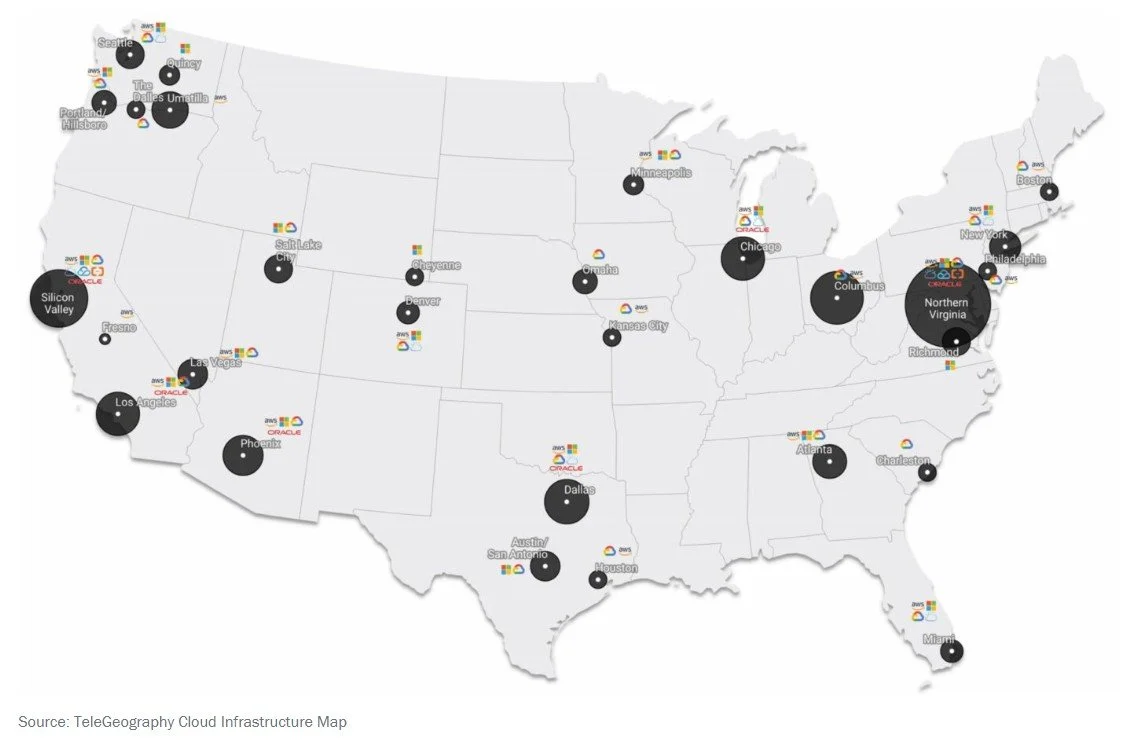
Here are a few of the environmental impacts from those data centers:
Air pollution, including greenhouse gas emissions from generators
Additional greenhouse gas emissions from excessive power consumption
Reduced available water due to excessive water consumption
Noise pollution
Habitat destruction
If you want to learn more about these impacts and how you can work to minimize them, I encourage you to start with this article from the World Resources Institute. Then, if you’re near a proposed or under-construction data center, reach out in your community to find an organization that’s working to limit environmental impacts and make the owners pay for those that are unavoidable. (These groups are popping up all over.)
Finally, be a smart AI consumer. Here are some suggestions from author and environmental leader Andrew Winston from a recent Substack post:
Use the right tool for the task
Use the appropriate tier on major platforms
Avoid prompting “extended thinking” or “deep thinking” unless it’s absolutely necessary
Avoid generation of images and videos
Control data input and output sizes
Tailor prompts to be clear and precise regarding what you’re looking for and what you want the system to generate
Start fresh or manage conversation length so it doesn’t reread everything when you give it a new prompt
Winston also provides clear instructions that you can give to any system to make it do many of these things automatically, every time you use it. I encourage you to check out his Substack post linked above or this LinkedIn postfor more information.
Remember, we’re all in this together. It’s up to us to figure it out.
Sources: www.nibib.nih.gov , www.news.mit.edu , www.scientificamerican.com , www.safe.ai , www.forbes.com , www.eng.vt.edu , www.swe.org , www.er.educause.edu , www.wired.com , www.andcable.com , www.staxengineering.com , www.wri.org