
Buyers’ Remorse

1960s Sears Catalog
I grew up in the 1960s and 70s – something of a golden era to be a kid in the US middle class. We lived in a modest but comfortable house in a quiet neighborhood. There was always food on the table and new clothes each fall. I remember when we upgraded from a small black and white t.v. to a “big” color t.v. We celebrated birthdays with cake and ice cream and new toys. When I was very young, we had one car, and then we got a second. Gas was cheap, so we drove everywhere and just filled up whenever the tank got low. We didn’t think much about where our trash went, we just put all the waste into the paper bags our groceries came home in, set them in metal trash cans outside, and took those down to the street for the garbage collectors. For many years I didn’t give a second thought to our consumption habits.
But eventually I started wondering how long we could keep this up – how many toys and cars and t.v.s would ever be made, and how big the garbage dumps would get. Now, 50+ years later, a lot of smart people are thinking about that, and scientists are performing detailed analyses. Their findings on the pace of our consumption can be found on the Earth Overshoot Day website. “Earth Overshoot Day” is the date each year when humanity’s demand for ecological resources and services exceeds what the Earth can regenerate in that year. In 2025, that date was July 24th. For 36 of the past 52 years that date has crept up earlier and earlier in the year – that is, we’re depleting the Earth’s resources faster and faster.
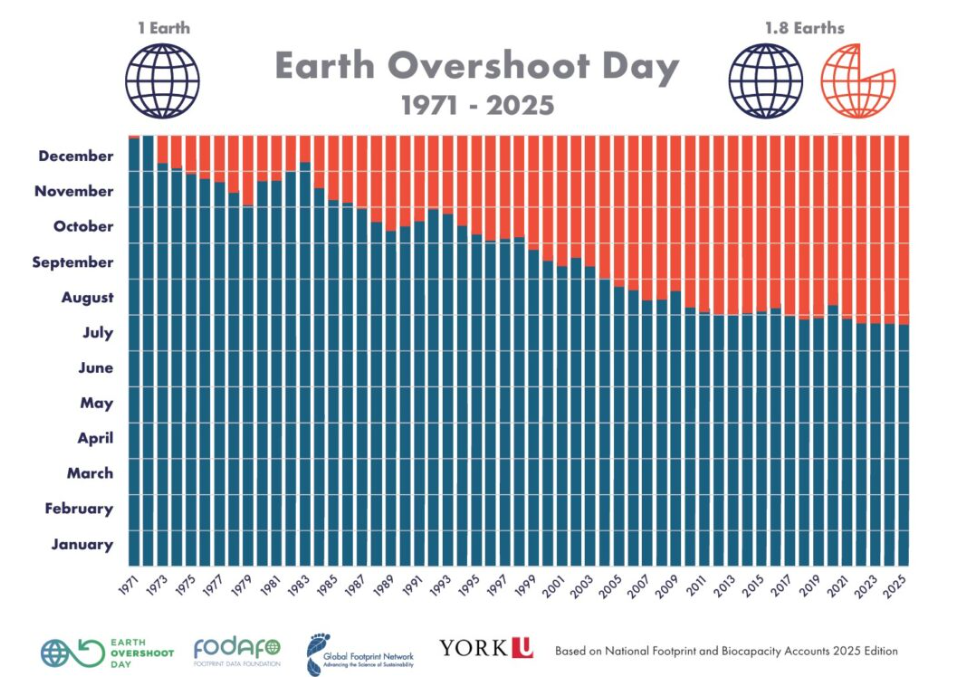
Scientists also calculate the date that Earth Overshoot would happen if people around the world lived like the people in each country. This year the Earth Overshoot Day for the United States was March 14 - that is, if everyone consumed like people in the US, we would have used up the year’s allotment of goods and services that the Earth can support last Saturday. Hmmmm. We’re not “the worst” – there are eight countries that have earlier Earth Overshoot Days. But there are eighty-two countries with later dates, some much later.
What do you think about that?
The good news is the folks at Earth Overshoot Day have solutions!
As always, remember that we’re all in this together. Our behavior affects the world.