
Making a Difference with Sheep
For this installment on people making a difference, I’m excited to write about a sheep farmer! Darnell Dugger is a Georgia rancher who raises Katahdin sheep and sells premium lamb sausage and ground lamb in the region around Griffin, GA.
“What?!? A blog about protecting the planet is promoting meat consumption?!?” Well, before you clutch your pearls a little too tightly, let’s do a reality check.
It is true that production and transportation of animals for food both have a huge impact on greenhouse gases in the atmosphere, contributing to the warming of the planet.
It is true that eating a plant-based diet is one of the best ways for individuals to reduce their “carbon footprint.”
It is also true that the US (and many other countries) are not about to go vegetarian.
So (since we’re all in this together) let’s eat less meat AND get smarter about how meat is produced.
Darnell Dugger is someone who is exploring and promoting solutions to reduce the environmental impact of sheep farming. His work in the farming and ranching industry is fascinating, and so is his personal story. Darnell grew up in the city of Columbus, GA – not on a farm. But he did spend many happy summers at his grandparents’ farm in Colfax, LA. Dugger went on to serve in the 1st Cavalry Division of the US Army in Operation Iraqi Freedom, then into the corporate world in software development. After a while, he decided a career in tech was not the life he wanted and, based on his love of farms and a prophetic dream about a sheep tugging on his leg (I kid you not), Darnell decided to become a sheep rancher! (Hear him tell the story in this interview.)
That dream led to Acre and Herd Ranch, where Dugger practices regenerative agriculture. For an in-depth discussion of what regenerative agriculture is, I recommend this Climate Rising podcast. Basically, it encompasses a variety of farming and ranching practices and management approaches that enhance and support the land and the surrounding community. Regenerative ag is not a clearly defined system or certification, but may include practices like:
Crop and herd rotation to prevent soil damage and depletion
Water management for conservation and prevention of harmful runoff
Use of natural methods of weed and insect control instead of harmful chemicals
No-till or low-till farming to avoid unnecessary soil disturbance
Use of cover crops to enhance soil health
As you might guess, these methods are not new. But they have had a resurgence in recent years as farmers and ranchers have rediscovered the advantages of the ways of past generations and indigenous peoples. It turns out that taking care of the environment is not only the right thing to do, but it can also yield better financial returns than some “modern” agricultural methods.

Benefits of rotational grazing
Darnell Dugger describes his ranch as “more than a business – it’s a commitment to stewardship.” His goals include supporting the community and leaving the land better than he found it. To make that happen, Acre and Herd practices rotational grazing. Moving herds from one pasture to another allows the soil to recover and regenerate naturally – which builds organic matter for healthier soil and enhances the water retention capability of the land, reducing harmful runoff into the local watershed.
But Dugger is a new rancher without a huge spread to allow infinite rotational grazing. How does he do it? He puts his sheep to work as “solar grazers.” As other landowners and developers across the southeast support clean energy by installing solar panels, management of the vegetation in those fields can be challenging. Enter: Acre and Herd Ranch sheep! Sheep grazing is cheaper than mechanical mowing, eliminates the need for herbicides with their chemical runoff, reduces emissions from mowing equipment, and provides quieter maintenance. On top of all that, the grazing sheep provide natural fertilizer for flowering plants that support local pollinators. And as Darnell’s sheep are out maintaining other fields, his pastures have a chance to recover. Win-win-win-win!
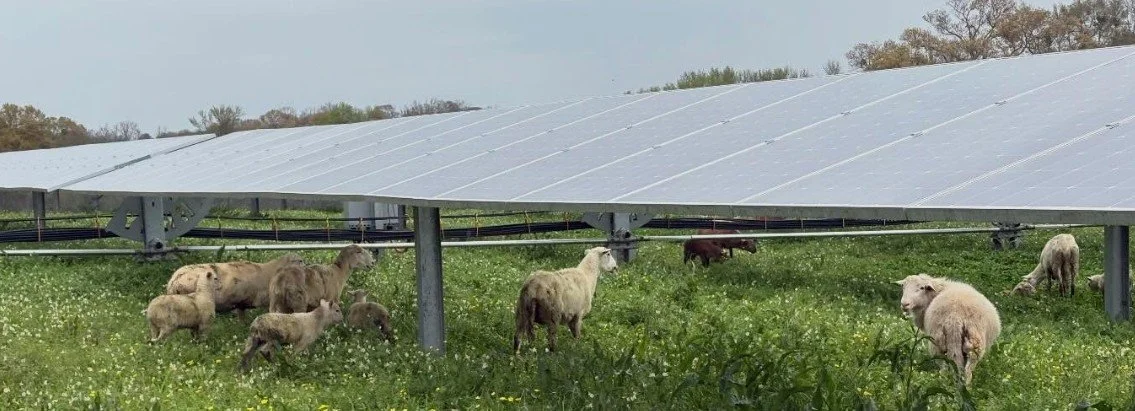
Acre and Herd’s Solar Grazers
As he so beautifully put it, “The value of solar grazing goes beyond the fence line. Every partnership is an opportunity to support working families, strengthen regional agriculture, and demonstrate that clean energy and local land stewardship can move forward together.”
To learn more about how Darnell Dugger is making a difference, I encourage you to read this interview on the Bold Journey website and to check out the links below:
Website: Acre and Herd
Instagram: acreandherdranch
Facebook: Acre and Herd Ranch
Linkedin: Darnell Duggar