
Making a Difference with Seaweed
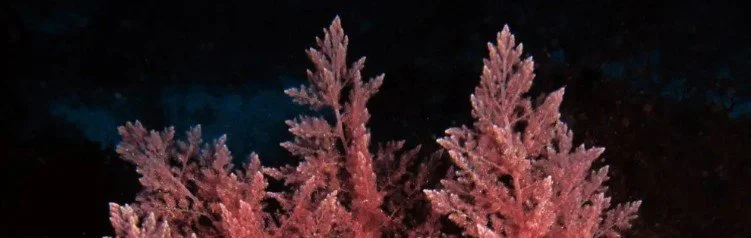
As an environmental obsessive in a family of beef lovers, I’ve tried for years to find a way to reconcile meat-eating and reducing greenhouse gas emissions. The impact of beef (and dairy product) production on the climate is real. One surprising element of that impact is cow burps (or “eructation”). The culprit in cow burps is methane - a heat-trapping gas more potent than carbon dioxide.
A cow’s digestive system converts high-fiber plants into energy for cow life, through chemical processes generating fermentation by-products including hydrogen (H2) and carbon dioxide (CO2) that are then converted into methane (CH4) by a microbe called methanogen. This methane is released from the cow’s body primarily in burps. Other ruminants (goats, sheep, bison, etc.) also produce methane, but according to the US EPA, over 95% of the methane emissions from US livestock animals come from beef and dairy cattle, amounting to more than 185 million metric tons (tonnes) of CO2 equivalent emissions.
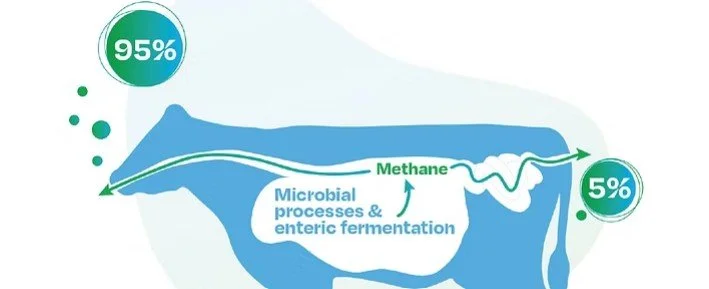
Image source: www.dairyconservation.org
There are plenty of online sources debating the comparison of livestock methane emissions to automobile emissions, so I won’t go down that road. Suffice it to say, cows create a lot of greenhouse gas emissions. And although methane does not persist in the atmosphere as long as carbon dioxide (about 10 years vs. hundreds of years), the immediate warming impact of methane is 86 times stronger than that of carbon dioxide, so methane emissions are an urgent issue.
That’s one reason why people concerned about the impacts of climate change have been asking you to eat less meat (beef in particular). We can definitely slow the extreme impacts of a changing climate by eating a more plant-based diet, and I encourage that. In addition, there are folks out there who are working on ways to reduce or trap the methane produced by cattle. Some methods that are being tested include cow masks to collect the methane, vaccines to get rid of the methanogen microbes in cows’ digestive systems, and breeding cattle for lower methane emissions. But my favorite (and I believe the most promising) potential solution is adding feed supplements made from seaweed that block the production of methane by the methanogen microbes.
Two people who have been blazing the trail to seaweed supplementation are Jennifer Smith of the Scripps Institution of Oceanography at UC San Diego and Matt Rothe of Blue Ocean Barns. (Both organizations are featured in a PBS documentary, Fighting Cow Methane With Seaweed.)
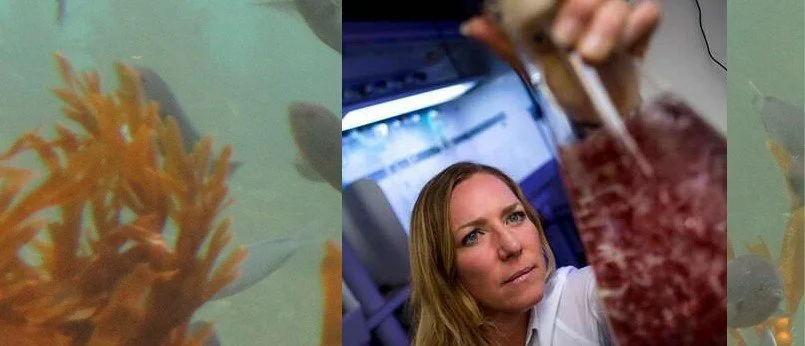
Image source: www.seaweedecologylab.ucsd.edu
Dr. Jennifer Smith is a scientist and professor who has spent more than 25 years studying marine community ecology and global change impacts to marine systems, including a special focus on phycology - the study of seaweeds. For the past several years Dr. Smith has been studying Asparagopsis, an edible red seaweed growing in tropical and subtropical regions which has been found to significantly reduce methane production when added to livestock feed. Smith and her team are performing ongoing research on Asparagopsis to identify the traits of seaweed collected from various locations: which ones perform better, grow faster, and are better at impacting the chemical process that produces methane in cow digestion. This research is helping to identify the best ways to scale up this potential solution to greenhouse gas emissions by livestock. Here’s a six-and-a-half-minute video that provides a great overview of what they’re up to.
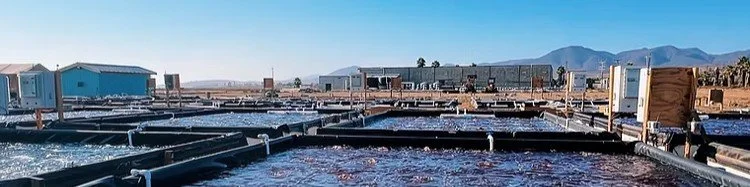
Image source: www.blueoceanbarns.com
Multiple companies in the US and Australia are working hard at commercializing the use of Asparagopsis in cattle feed, and one of them is Blue Ocean Barns, co-founded by Matt Rothe. Rothe is a farm boy turned sustainable businessman thanks to a BA in Environmental Earth Science and a Master of Business Administration degree, plus more than 25 years of work leading and educating in improvement of food system design. In 2019, Rothe and his co-founder (now Board Member and Advisor) Joan Salwen, created Blue Ocean Barns, a public benefit corporation dedicated to expanding the use of seaweed supplementation in cattle feed. According to the website, their product, Brominata®, has been demonstrated to reduce methane emissions in cattle by up to 80%, is safe for the animals, and has no impact on the taste, quality, or nutrition of their milk or meat. (See linked studies in their FAQs.) Getting production of this potential game-changing plant, Asparagopsis, scaled-up to meet our consumption demands requires something other than harvesting it from the sea, which could impact sensitive marine ecosystems. So Blue Ocean Barns (and several other producers) have developed systems for cultivating it in tanks on land.
Brominata is currently approved for commercial use in Mexico and California, with plans to expand in the US. Possibly the biggest hurdle to widespread use is getting FDA approval, since methane-mitigation products for livestock are currently classified by the FDA as drugs and must go through a multi-year approval process. Meanwhile, H.R. 2203, the “Innovative FEED Act” has been introduced in Congress to amend the Federal Food, Drug, and Cosmetic Act, reclassifying these products as food additives instead of drugs, so they won’t have to go through the arduous approval process. The bill is currently in the House Committee on Energy and Commerce – you can support this bill by contacting your Member at the link on this page.
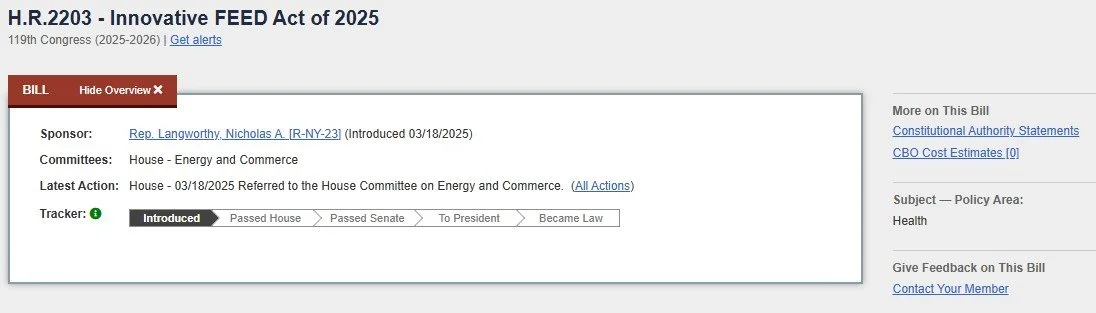
Source: www.congress.gov/bill
Once again, you can see how we’re all in this together. Reducing our impacts on the environment requires us to understand those impacts and take immediate action. When it comes to reducing methane emissions from cow burps, I encourage you to take action as consumers, role models, and citizens.