
Breaching Our Planetary Boundaries
Photo credit: NASA
Welcome, October!
Since it’s the beginning of a new month, I’ll take a break from “people making a difference” and focus on what’s happening to the environment and how we’re doing. But what does that even mean, how we’re doing? With all the conflicting news, data, stories, propaganda, and general conversation around the environment and climate, how can we figure out how we’re doing?
One way is from the research on “Planetary Boundaries”. Planetary Boundaries are scientifically identified guardrails that define a “safe space for human development” on Earth. This evaluation framework was first developed in 2009 by a team of 29 scientists led by Johan Rockström and Will Steffen. This group of Earth System and Environmental Scientists identified nine Earth processes that need to stay within a certain range to accommodate human life as we know it. Those processes include freshwater change, ocean acidification, land system change, biosphere integrity, biogeochemical flows, novel entities (synthetic materials), stratospheric ozone, atmospheric aerosol loading, and climate.
Image credit: stockholmresilience.org
The Planetary Boundaries framework established how to quantify these processes and conditions and how to measure changes in them over time. Those changes are evaluated based on a “norm” of the relatively stable conditions during the Holocene geological epoch, that is, the time and conditions that we are living in now which have allowed human life to flourish over the past 10,000 years. The extremes and limits of the Holocene epoch establish the “safe zone” for human well-being. There has been some debate about the relevance of this norm, since supporting billions of humans has different requirements and impacts than supporting hundreds of thousands of humans. But it seems to be a reasonable way to evaluate how we may be impacting our very own existence. Since 2009, other scientists have recommended additional boundaries to consider, but for this piece I’ll stick to the original nine.
The Stockholm Resilience Centre website provides more details on the history, concepts, science, and recent developments related to this work, if you’re interested in learning more. Meanwhile, here is a summary of those planetary boundaries that scientists continue to study and report on:
Freshwater change – water use and management that impacts availability of freshwater for plants and animal
Ocean acidification – increasing ocean acidity that impacts the ability of marine organisms to build shells and skeletons
Land system change – loss of forests due to expansion of grazing and crops, illegal logging, infrastructure expansion, and climate change that reduces available habitats and natural sequestration of carbon
Biosphere integrity – worldwide loss of species, ecosystems, and related ecological functions
Biogeochemical flows – disruption of nutrient cycles that regulate soil health due to excessive use of fertilizers and introduction of pollutants
Novel entities – addition of synthetic chemicals, plastics, and other human-made materials into the Earth’s natural systems, impacting species in known and unknown ways
Stratospheric ozone – thickness of the protective ozone layer that shields life from harmful UV radiation from the Sun
Atmospheric aerosol loading – concentration of tiny particles suspended in the atmosphere that impact human health and disrupt climate processes
Climate – increase of specific heat-trapping gases in the atmosphere that raise the temperature of the Earth, disrupting life on land and in the oceans in various ways
The state of our planet on all of these measures is graphically shown as a polar graph with a sector (or two) for each process. Here is the graph for 2009:
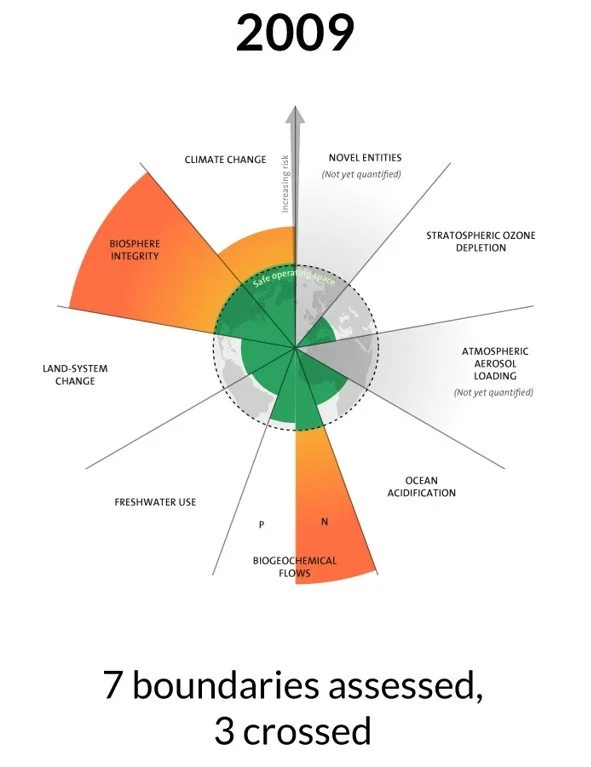
Image credit: Stockholm Resilience Centre
The circle shown as a dotted line represents the “safe operating space” for the processes evaluated. The slices of the pie that are only green are all functioning in the safe zone. When the evaluation of the state of a process indicates that it has gone beyond what is considered safe, it is shown in orange, deepening to red as conditions worsen. As of 2009 biosphere integrity and biochemical flows of nitrogen were already in the red (high risk) zone. Climate change was out of the safe zone into the orange part of the risk zone.
And here is the graph for 2026:
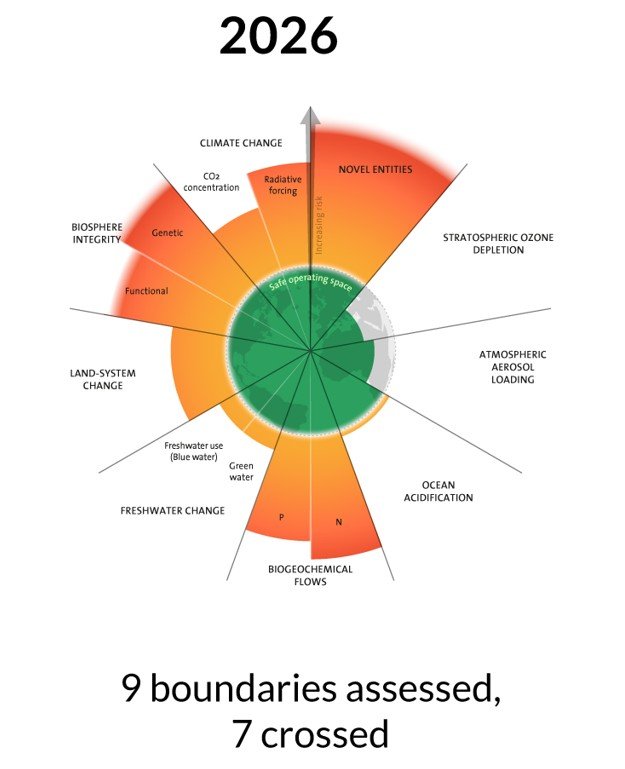
Image credit: Stockholm Resilience Centre
As of this year, scientists have determined that we are beyond the safe zone in seven of the nine processes assessed.
It might be tempting to think that these are just colorful charts created to frighten us. How do they know the state of these things? How do they know the risks involved? Before you dismiss this evaluation, I encourage you to read the 2026 Planetary Health Check Report from the Planetary Boundaries Science Lab. Don’t be intimidated by its 104-page length - it is beautifully prepared and very readable. It includes a short glossary of key terms and five key takeaways, backed-up by explanations of their framework and evaluation methods and featuring lots of photos and graphs to illustrate their findings.
The Planetary Health Check may be my favorite report among all that I have seen while doing sustainability work. It reflects the interconnectedness of everything, how humans are a part of the natural world, and how we have pushed it out of balance. I trust the research and knowledge of the 70+ scientists and editors who compiled the information and the 16 others who reviewed it. I respect that there are 422 references in the back of the report and appreciate that there is a link to each one.
I do not like what the report says. In summary:
“The science is clear: We have pushed the planet far beyond its Safe Operating Space. Despite some positive developments, our current efforts are far from sufficient. The window of opportunity to act and avoid irreversible change is narrowing, but it is still open. Through urgent and decisive action, we can change our trajectory towards sustainability. Returning to the Safe Operating Space is the defining task for a stable and livable future.”
BTW - I also appreciate that they have included a section called “Solutions and Outlook.”
Now it’s up to us. It’s up to us to not only do our part, but to insist that governments and corporations do theirs. The challenge is enormous. And we are all in this together.
What will you do today to lend your talents?
Here are some excellent videos on the topic:
Planetary Boundaries: What are they and why shouldn't we cross them? - Financial Times Rethink (4 mins.)
How Stable is Our Planet - Planetary boundaries and earth resilience presented by Johan Rockström (8 mins.)
Johan Rockström’s Ted Talk - The Tipping Points of Climate Change (19 mins.)