
Biodiversity – the 70s to Now
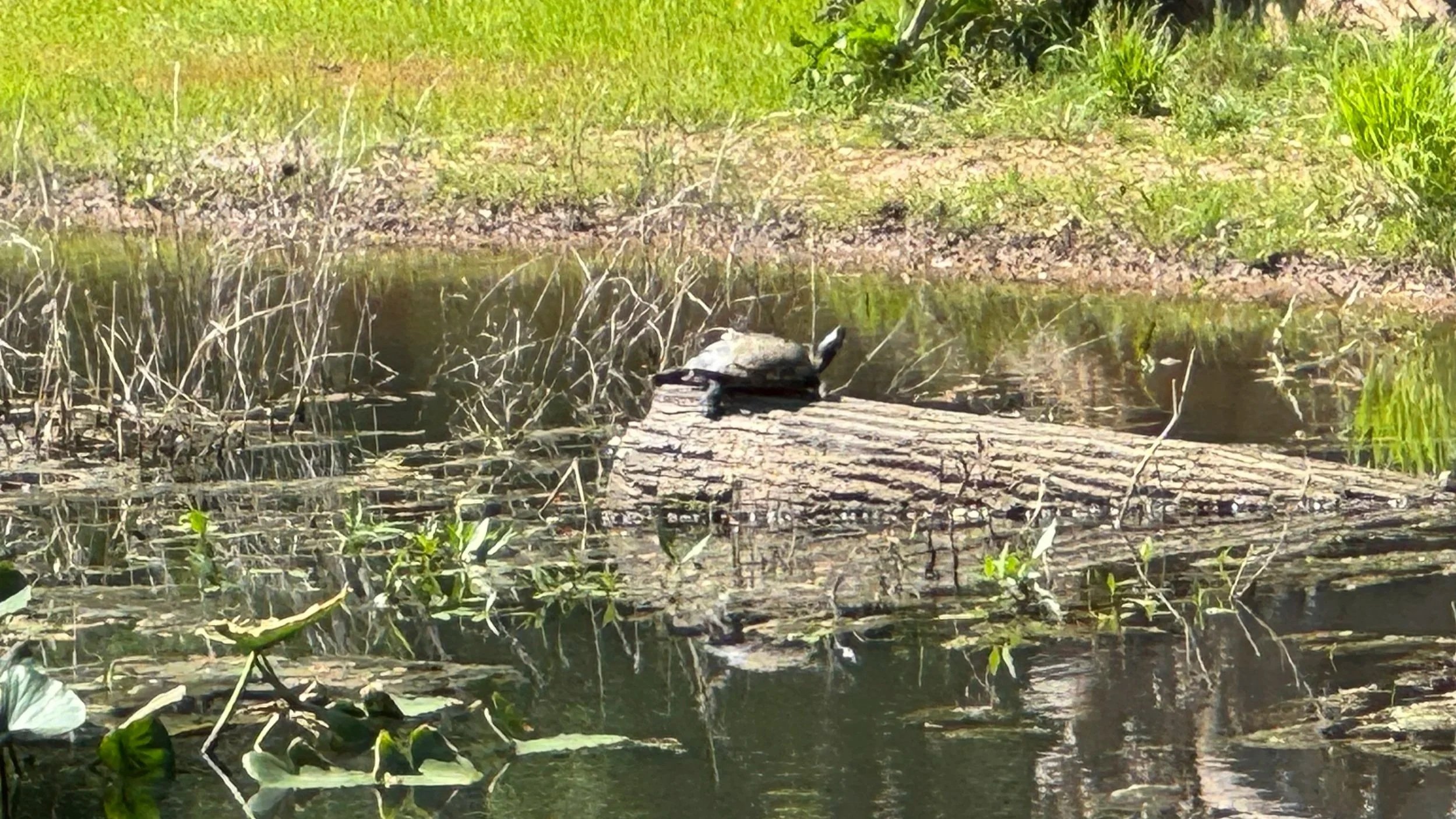
Turtle in the Sun, Arlington, VA
Creating the last three blog posts has taken me on a bit of a roller coaster ride. Going into it, I knew I would find evidence of ways we’ve corrected some serious human environmental impacts, and I did. But in the process, I was also reminded of issues we’ve failed to address or are backsliding on. Today’s post will be the last comparing the status of environmental issues identified in the 1971 book TheSunisGoingDownforAllofUs to the status of those issues now. It focuses on wildlife impact. I saved this one for last because there’s no way to sugar-coat it – the statistics are grim.
But my goal isn’t to spread bad news. My goal is to share important information and provide support to those who want to make the world a better place for future generations. So, I’ll follow the usual pattern – quoting the book from 1971, then sharing what has happened in the past 55 years to get us to where we are today. But after that, I’ll give you the bigger picture of our impact on wildlife, and links to some programs that are making a difference.
Here are a few quotes from The Sun is Going Down:
90% of the vicuna in Peru have been killed in the past ten years – to end up on our backs.
The red wolf and the Florida panther are becoming extinct through loss of habitat.
Through the use of pesticides, America is killing off her own national symbol, the bald eagle.
The book goes on to cite declining populations of at least 10 other animals, but you get the picture, right? So, what do the numbers tell us about how these species have done since then?
1970s Wild Pop. 2025 Wild Pop.
Vicuna +/- 6,000 +/- 350,000
Red Wolf < 20 +/- 31
Florida Panther < 20 +/- 200
Bald Eagle < 1000 > 300,000
For these particular species, it’s a mixed story. Public and government efforts have brought about remarkable recoveries for the Vicuna and the Bald Eagle. But the Red Wolf and Florida Panther have not fared as well. Efforts to help them rebound continue, but both are plagued by habitat loss and discontinuity, pollution, poaching, vehicle collisions, and predation by invasive species.
But what difference does the population of one species make? Species have come and gone throughout the history of the planet. Doesn’t nature always balance things out? Well, sort of. As my Environmental Studies professor at LSU used to say, “Nature always gets the last laugh.” In other words, nature will respond to whatever we throw at her, but that last laugh may be at our expense.
In recent decades, scientists who study the natural world have become alarmed about the acceleration of biodiversity loss. Biodiversity is a term that can refer to several different things:
Genetic diversity – the variety of genes (inherited traits) within a particular species. Genetic diversity is critical for species reproductive health and adaptation to environmental changes.
Species diversity – the number of different species in the world or in a given area. Species diversity is critical to maintaining balance in an ecosystem – if one species population grows too fast, it can wipe out other species, endangering the entire ecosystem.
Ecosystem diversity – the number of different habitats and ecosystems in the world or in a given area. Ecosystem diversity is critical to the health of the planet, since different species thrive in different environments. Try to imagine a world of only prairies, only forests, or only swamps, and you can see why ecosystem diversity matters.
This post is focused on “species biodiversity.” And since we humans tend see ourselves as separate from the natural world, let me remind you that we’re part of that “species biodiversity.” We’re part of that living network that needs to remain in balance or nature’s next laugh will be on us.
So how are we doing on species biodiversity? This is where the numbers look grim. Many news outlets have reported the recent Living Planet Index statistic that we have lost 73% of the world’s biodiversity since 1970. While there is verified science behind that statistic, the truth is more complicated than one number (and maybe not quite as depressing). Since this number represents the average decline in biodiversity, it doesn’t tell us what’s driving that average – which populations are in catastrophic decline, which ones are doing fine, and which ones are growing too fast. [Also, the research only includes vertebrates (mammals, birds, fish, reptiles, and amphibians), and only the populations that scientists can find and count or reasonably estimate.]
Our World in Data shares a deeper dive into the data to help us understand what’s going on. If we remove the 356 most severely reduced populations (2.4%) from the total, the average change shows a slight improvement over the past 50 years. But that still doesn’t tell the whole story. We need to account for the sway from extremes on the other end – the species that have experienced population explosions. The Living Planet Index did an analysis in 2022 looking at outliers at both extremes of their data at that time to get a better handle on the average decline. Removing the data for species in extreme decline and those whose populations had exploded brought the reduction number back to about a 48% average decline since 1970. Still not a great number.
As discouraging as that statistic may be, I know we can do hard things. There are private and government programs investing in biodiversity support and habitat restoration. And while the money and laws are critical to success, the most effective programs integrate community commitment and involvement. Here are a few examples of the thousands of programs using scientific research, public and private funding, and community involvement to make a difference:
Queen Bess Island LA Restoration
Great South Bay Oyster Project
Remember, we’re all in this together. What’s happening in your neck of the woods?